
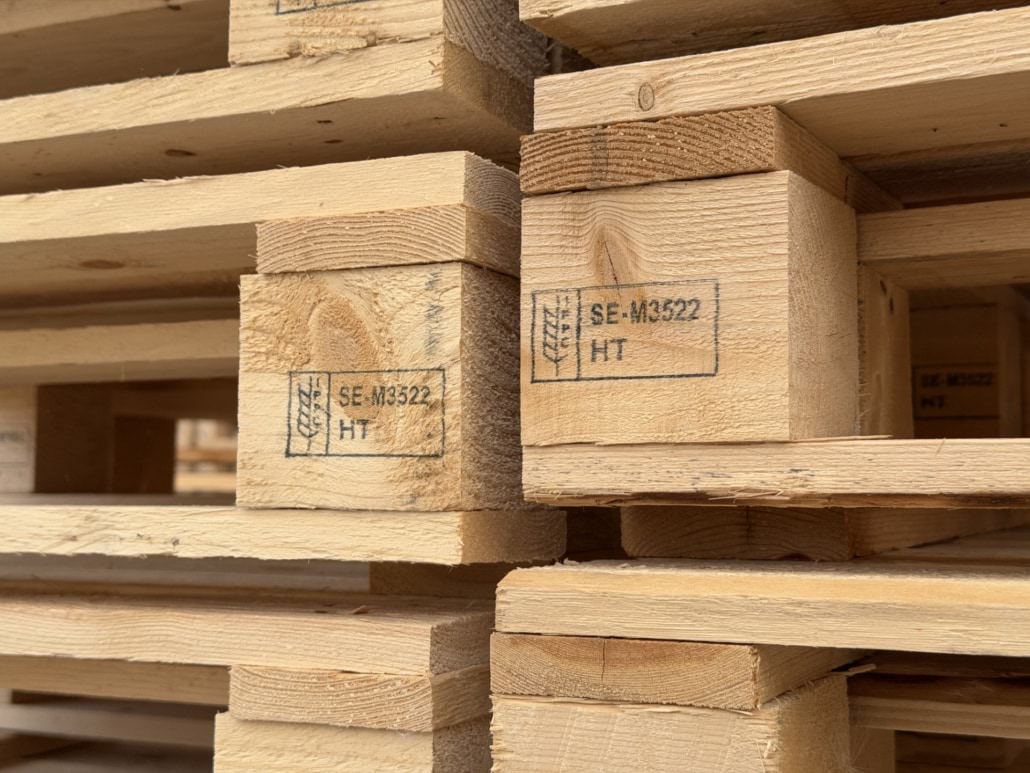

ISPM 15 for pallets and wood packaging – marking and export requirements
ISPM 15 is an international phytosanitary standard for wood packaging material. If the destination country requires ISPM 15, wood packaging material within scope must be debarked, treated in accordance with the standard and correctly marked. Check both the pallet and the other wooden components, including pallet collars and dunnage. The mark indicates that phytosanitary measures have been carried out. The pallet’s load capacity, condition and suitability for the load must be assessed separately.
Check the destination, all packaging components and how the pallet will be used before dispatch.
In this export guide – choose a section
01Destination country
When do you need to check ISPM 15 requirements?
Check the shipment’s destination and transport route before choosing packaging. Many countries require ISPM 15 for wood packaging material entering the country. There is no general marking requirement for trade within the EU, but specific rules apply in certain cases, including packaging from demarcated areas affected by particular quarantine pests. See the Swedish Board of Agriculture’s guidance on wood packaging material used in international trade.
Check the following for your shipment:
- Destination country and region. Do not rely solely on descriptions such as “Europe” or “EU”. Territories and regions may have specific phytosanitary rules.
- Current import requirements. Check which materials and packaging components are covered, which treatments are accepted and whether any specific conditions apply to the shipment. Verify the information with the destination country’s plant health authority. You can find the authority through the IPPC country list.
- Transit and onward transport. Specify whether the goods will be transferred between vehicles, whether the packaging will be replaced or whether the same pallet will travel to another country. Check the relevant requirements for the entire planned transport chain.
- The recipient’s requirements for the load carrier itself. Confirm dimensions, handling, load capacity and any pallet standards in addition to the phytosanitary requirements.
Example – onward transport: The goods are first delivered to a warehouse within the EU and then sent on to England on the same pallet. Choose packaging that also meets the requirements for the later stage. England is covered by Great Britain’s ISPM 15 requirements for solid wood packaging material from the EU that falls within scope. See the Forestry Commission’s current import guidance.
02The IPPC mark
How to read the IPPC mark
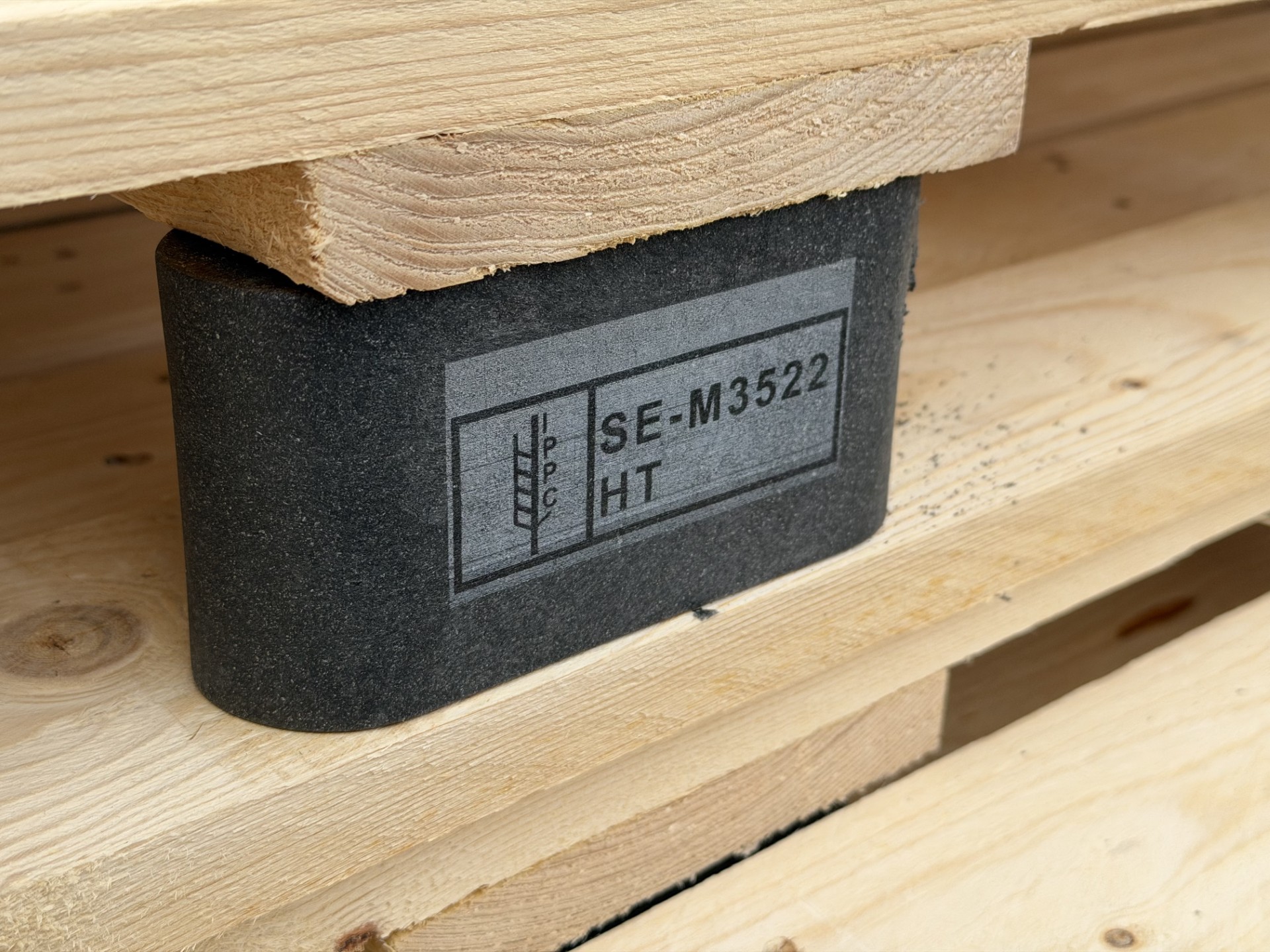
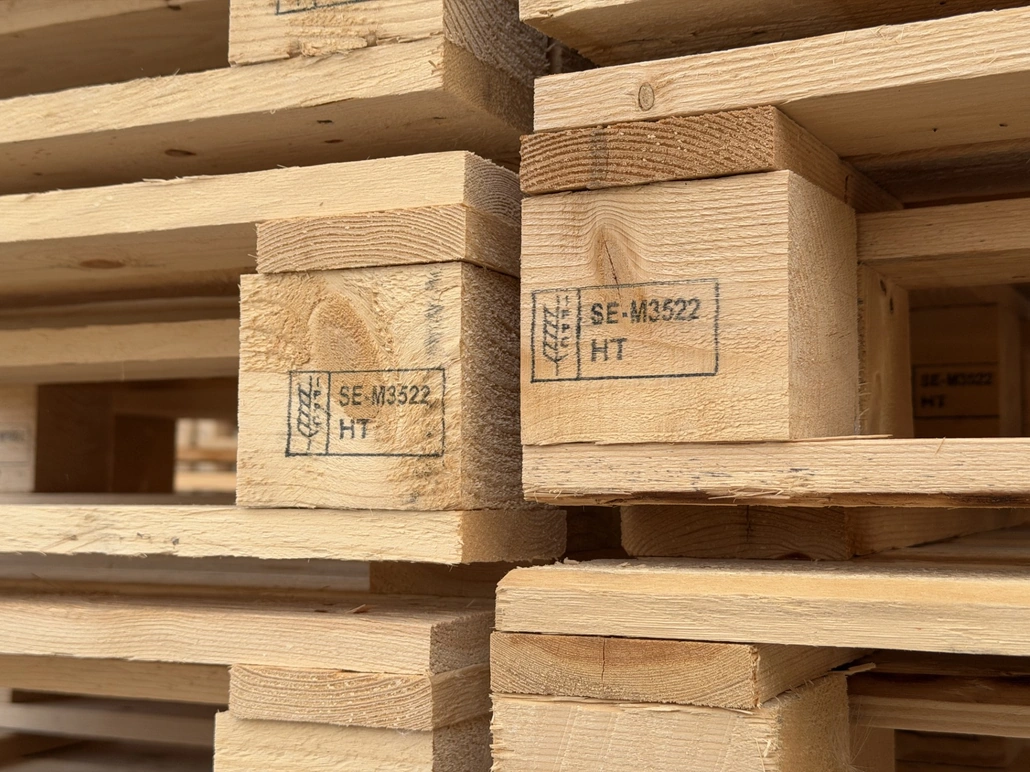
ISPM 15 is the name of the standard. IPPC stands for the International Plant Protection Convention, and the IPPC symbol forms part of the official mark. In practice, the complete mark is often called the IPPC mark or IPPC stamp.
| Part of the mark | What you should be able to read |
|---|---|
| IPPC symbol | The official symbol, separated from the codes. |
| Country code | Two letters, such as SE for Sweden. The code identifies the country where the operator is registered, not the shipment’s destination. |
| Producer/treatment provider code | Identifies the responsible producer, treatment provider or other operator authorised to apply the mark. |
| Treatment code | Indicates the approved treatment used, such as HT. |
The mark must have a border and a line separating the symbol from the codes. It must be legible, durable and non-transferable to other packaging. It must be visible when the packaging is in use, preferably on at least two opposite sides. The mark must not be hand-drawn. “HT” on its own, an IPPC symbol without codes or a supplier’s name does not constitute a complete mark. See IPPC guidance on wood packaging material and marking.
Example of what the codes mean: SE-M3522 together with HT indicates the Swedish producer/treatment provider code M3522 and heat treatment. A complete mark also requires the IPPC symbol and the correct layout. The code text alone is not sufficient.
If the mark is missing, illegible or appears incomplete, establish whether the packaging meets the requirements before a shipment that requires ISPM 15. Ask the supplier to assess whether the packaging can be used, needs to be replaced or should be handled in another way within an approved system.
03HT and drying
What does HT treatment mean?
HT stands for heat treatment and denotes conventional heat treatment. The temperature must be at least 56 °C throughout the wood, including its core, for at least 30 continuous minutes. Warm air in a timber kiln is therefore not sufficient on its own. The treatment must meet the standard’s requirements and be carried out within a controlled system. See ISPM 15, Annex 1.
Is dried timber the same as HT-treated timber?
Conventional timber drying aims to reduce the wood’s moisture content. Drying can be combined with an approved phytosanitary treatment, but describing a pallet as “dried” does not in itself show compliance with ISPM 15. Nor does the HT mark indicate a particular final moisture content. Specify any moisture requirements separately.
The Swedish KD 56 °C/30 min system meets the temperature and time requirements for heat treatment. It must be distinguished from a general statement that timber has been dried. When timber from this system is used for ISPM 15 packaging, the requirements for an approved treatment provider, traceability and marking must also be met. A KD mark on the timber does not replace the complete ISPM 15 mark on the finished export packaging. See the Swedish Board of Agriculture’s information on the KD system and the requirements for ISPM 15 marking.
The wood must also be debarked. Only the limited amounts of residual bark permitted by the standard may remain. Treatment reduces the risk of spreading plant pests but provides no lasting protection against new infestations. HT is one of the standard’s treatment codes; the others are DH, MB and SF. Not all methods are permitted or used in Sweden. Read the code on the packaging concerned.
Treatment does not determine a pallet’s load capacity
ISPM 15 does not specify how many kilograms a pallet can carry or whether it is suitable for pallet racking. Assess its design, load distribution, support surfaces, lifting method and condition separately. The same pallet is loaded differently when standing on a level floor and when resting on racking beams.
A EUR or EPAL mark does not replace the ISPM 15 mark. EPAL lists quality, treatment and repair marks as separate elements in its marking guide for EPAL pallets. When choosing EUR pallets you need to check both the marking and whether the pallet is suitable for the load and handling conditions.
Read more about the difference between EPAL marking and ISPM 15 and how to check licence details.
04All packaging components
Which materials and packaging components are covered?
Check every packaging component. A marked pallet tells you nothing about the treatment or marking of loose components added later.
Solid wood in components such as boards, battens, blocks and runners is normally covered. Packaging made entirely of processed wood, such as plywood, OSB or particleboard manufactured using glue, heat or pressure, is exempt from ISPM 15. Packaging made entirely of wood no more than 6 mm thick is also exempt. Planing or conventional drying alone does not make solid wood exempt. See the Swedish Board of Agriculture’s material exemptions.
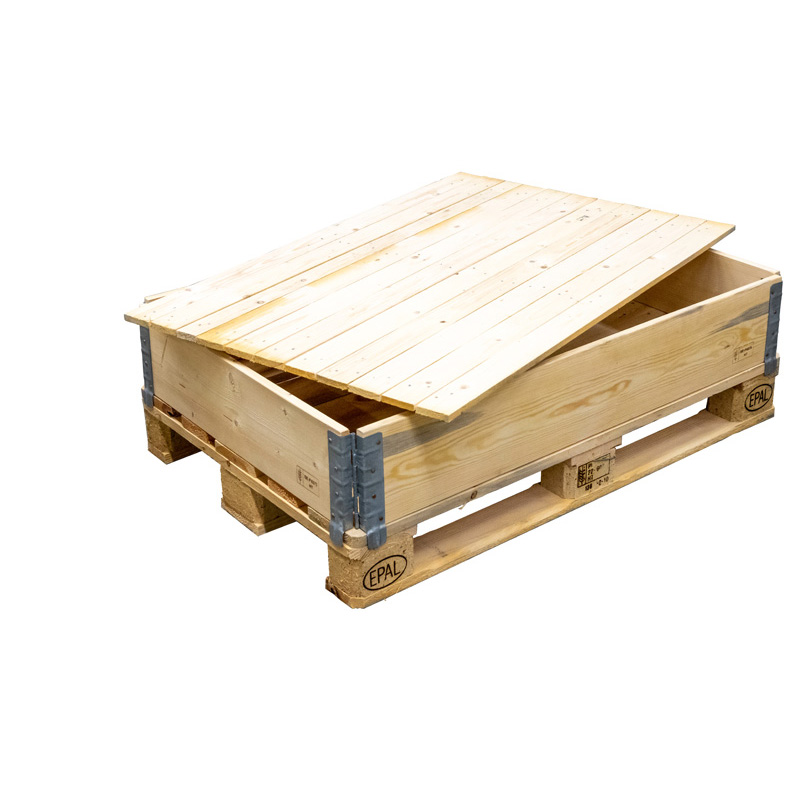
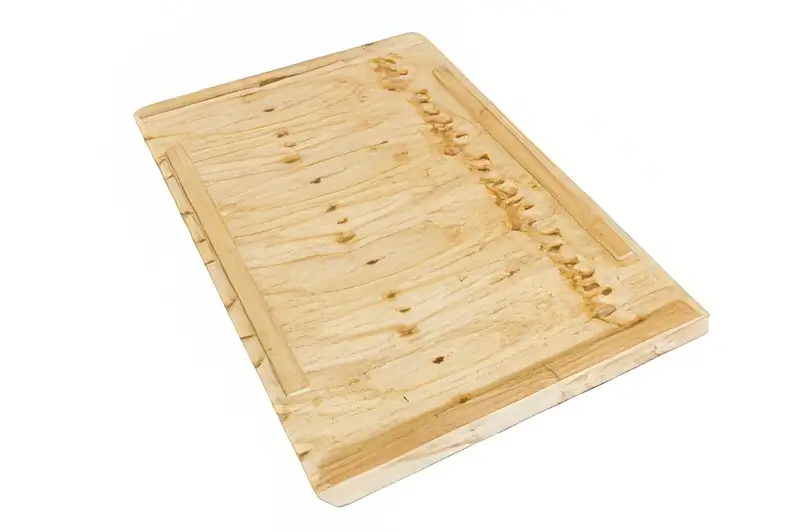
The table applies when the destination requires ISPM 15 for the wood packaging material concerned.
| Packaging type | What needs to be checked? | Relevant exemption or limitation |
|---|---|---|
| Pallet with solid wood boards, battens or blocks | Approved treatment, complete marking and any repairs. | The exemption for processed wood blocks does not apply to the pallet’s other solid wood components. |
| Solid wood pallet collar | The collar’s own treatment and marking, separately from the pallet’s. | Metal hinges do not change the requirement for the wooden sides. |
| Solid wood lid | The lid’s treatment and marking. | A marked base does not establish the lid’s compliance. |
| Plywood lid without solid wood components | That all wooden components are made from exempt panel materials. | The standard does not require plywood to be HT-treated or ISPM 15-marked. |
| Plywood lid with solid wood battens | The battens’ material and compliance, and the marking of the assembled unit. | The panel’s exemption does not automatically extend to the battens. |
| Box or crate combining panels and solid wood | The base, frame, runners, battens and internal supports, and the marking of the unit. | A construction is not exempt simply because its walls are made of plywood. |
| Loose solid wood dunnage, wedges and spacers | Treatment and a complete, legible mark on every piece used, including after cutting. | The pallet’s mark does not cover loose dunnage. |
| Packaging made entirely of wood no more than 6 mm thick | The thickness of the wood throughout the packaging. | The exemption does not apply if thicker solid wood components are included. |
Specify whether your plywood lids need retaining battens underneath to keep them in place. The same material checks are needed for custom boxes and wooden crates.
A permanently assembled unit combining treated solid wood and processed wood can be marked as a single unit. The mark may be placed on the plywood component to keep it visible. This does not mean the plywood itself has required treatment. The same option does not apply to a temporary combination of a pallet, loose collars and a lid. See ISPM 15, Annex 2, on composite units.
Pallet collars and loose dunnage need separate checks
Check every pallet collar included. Also check any wood added by the packing team, such as wedges against the goods, supports beneath a machine or bracing inside a container.
Example – cut dunnage: A treated and marked timber batten is cut into three supports. If only one support retains a complete mark after cutting, the other two lack the required marking. Plan cutting and marking so that each piece meets the requirements. Any additional marking must be applied by an authorised operator. See the Swedish Board of Agriculture’s instructions for dunnage.
05Reuse
What are the rules for new, used and repaired pallets?
New pallets: Check treatment and complete marking when ISPM 15 is required. You still need to carry out these checks if the pallet is new or sold as an export pallet.
Used pallets without alterations: Under ISPM 15, a correctly treated and marked pallet does not need to be treated or marked again simply because it is reused. This applies throughout the pallet’s service life, provided it has not been repaired, remanufactured or otherwise altered. The mark therefore has no general expiry date, but the pallet must still be fit for use and the requirements for its next destination must be checked. See ISPM 15, section 4.3.1.
Repaired pallets: The original stamp is not sufficient to demonstrate that a subsequent repair meets the requirements. For repairs in Sweden, the Swedish Board of Agriculture states that only operators with marking authorisation may repair packaging already bearing an ISPM 15 mark. No more than one third of the components may be replaced for the work to count as a repair. Replacement components must be marked and traceable. Under the Swedish guidance, components from used ISPM 15 packaging may not be used as repair components.
Remanufactured pallets: In Sweden, the Swedish Board of Agriculture requires the entire packaging unit to be heat-treated again if more than one third of the components are replaced. Previous marks must be removed and the packaging must be marked again. See the Swedish Board of Agriculture’s rules for repair and remanufacture.
If a board has been replaced, the design has been altered or the history is unclear, establish whether the packaging still meets the requirements before exporting. If you see signs of active pest infestation, a legible mark alone is not sufficient. Also check for cracks, decay, damaged blocks and other defects that affect handling.
06Documentation
What documentation do you need?
Distinguish between three types of evidence and information:
- The mark on the packaging. This identifies the approved phytosanitary treatment within the ISPM 15 system. Under the standard, a separate phytosanitary certificate is then not required for the packaging itself. Documentation requirements for the goods and destination must be assessed separately. See ISPM 15, section 3.1.
- The supplier’s authorisation or certificate. This describes the operator’s authorisation or the conditions that have been assessed. It does not replace the required marking on the packaging supplied.
- Information for your order. Specify which components must comply with ISPM 15 and what treatment and documentation are needed. Ask the supplier to confirm the requirements for your order. A drawing, materials list and any photographs of existing packaging can help clarify which components the order covers.
GLF’s ISPM 15 certificates and marking authorisations
Our Sustainability & Quality page contains our published ISPM 15 certificates. Open the document for the operation relevant to your order:
 View the original
Marking authorisation · Sweden
Genarp
Authorisation codeSE-M3522
- Company
- GLF Genarp AB
- Site
- Genarp
- Certificate dated
- 28 October 2024
- View the original
Marking authorisation · Sweden
Sävsjöström
Authorisation codeSE-G3550
- Company
- GLF Träab AB
- Site
- Sävsjöström
- Certificate dated
- 15 April 2024
- View the original
ISPM 15 certificate · Poland
Mielec
Authorisation codePL-18926HT
- Company
- GLF Polska Mielec Sp. z o.o.
- Site
- ul. COP-u 3, Mielec
- Certificate number
- DBL-2026-6159-01-BLS
- Period stated in the certificate
- 9 October 2026–8 October 2027
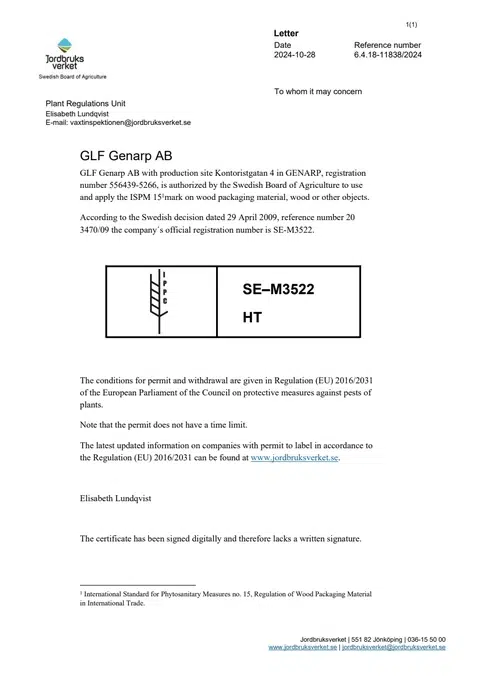
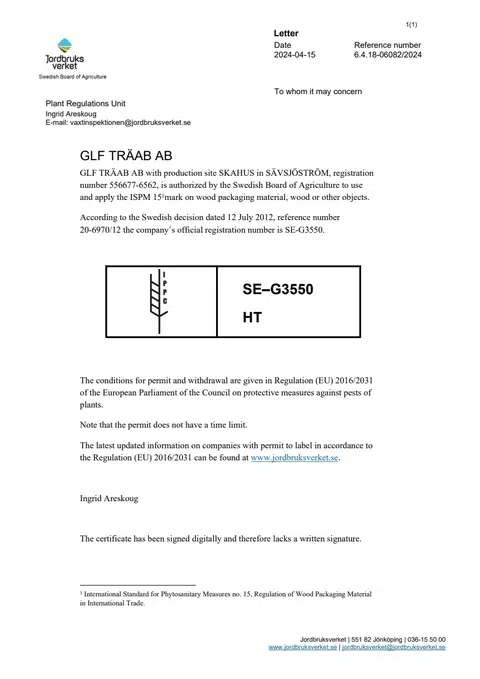
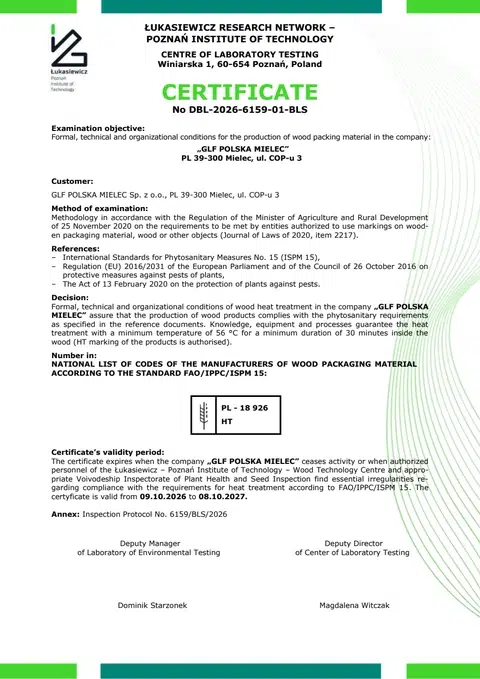
When checked on 11 October 2026, GLF Genarp AB and GLF Träab AB were listed in the Swedish Board of Agriculture’s public authorisation list under codes SE-M3522 and SE-G3550 respectively. The Swedish certificates state that the authorisations have no time limit. Check the authority’s authorisation list for current status. For Mielec, the period is taken from the published certificate. Its current registry status has not been checked separately.
The documents apply to the companies and sites specified in each document. Confirm treatment, marking and suitability for the delivery concerned. The certificates supplement the purchasing information and do not replace the ISPM 15 mark on the packaging.
07Ordering
How to order the right packaging from GLF
Choose a design suited to the goods and handling conditions, and include the phytosanitary requirements in the same enquiry. In addition to EUR pallets, you can compare EU pallets with wooden blocks, 5D full-size ISPM 15 pallets and industrial pallets. A product name does not replace an assessment of the load and handling conditions or confirmation of the marking requirements.
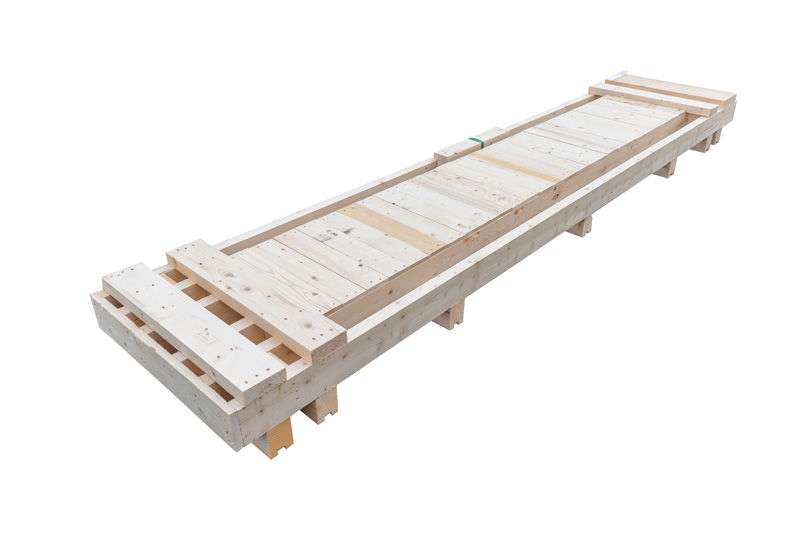
For goods with specific support surfaces, dimensions or protection needs, a custom pallet or custom packaging solution may be suitable. Describe the complete solution, including wooden components to be fitted during packing or added later.
Ordering checklist
Send the information to GLF for a quotation and a packaging proposal. Specify what has already been established and what needs to be clarified, so that the enquiry clearly describes the design, treatment and marking requirements.

Leave a Reply
Want to join the discussion?Feel free to contribute!