PACKED WITH INNOVATION
Customised Products
GLF designs and manufactures custom pallets and wooden packaging for your goods, handling and packing process.
Custom pallets and wooden packaging for industry
GLF manufactures custom pallets, load carriers and wooden packaging for industrial applications. Compare custom packaging and custom crates and boxes with the other products below.
- GLF Genarp AB in Genarp manufactures custom pallets, wooden boxes and crates.
- GLF TRÄAB AB in Sävsjöström manufactures custom wooden packaging and timber components, including boxes and crates for machinery-industry customers.
GLF develops the construction around your goods and agrees the manufacturing and delivery arrangement with you.
Wooden drums for Husqvarna chainsaw chains, 2020–2021
GLF developed wood-based packaging for Husqvarna chainsaw chains for transport to the USA. Development began in 2020 and included prototypes, a trial series and external testing before Husqvarna’s first regular order of 5,000 units in April 2021.
Explore the Husqvarna packaging case.
When does a standard product fit—and when is a customised product useful?
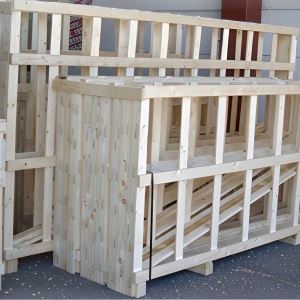
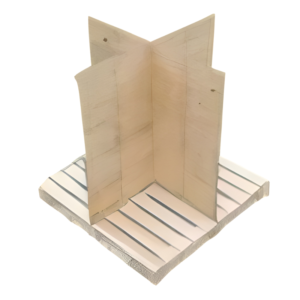
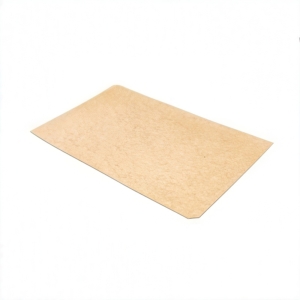
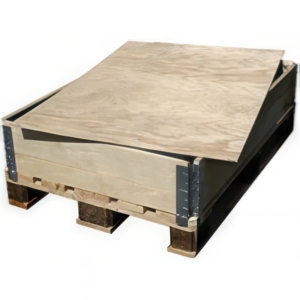
GLF offers standard formats for recurring packing, storage and transport needs. When your goods need different dimensions, materials, handling or protection, we adapt the packaging to the application. The range includes custom crates and boxes, custom packaging, custom pallets, and chipboard and plywood pallet lids.
Want to learn more about the manufacturing behind our solutions? Explore our production units in Sweden and Poland.
What to include in a custom-packaging enquiry
Start an enquiry by describing what the product will be used for and the goods it must support or contain. Include the goods’ length, width, height and weight, together with how they will be lifted, moved, stored or packed. Explain where support is needed, what type of protection is relevant and whether you already have a pallet, lid, crate, box or packaging format in mind. If available, attach a drawing or simple dimensional sketch.
Include the required quantity, destination and whether you need packaging for one project or a recurring flow. Send the dimensions, weight, handling information and drawings you have. GLF can help develop the brief and assess an existing design or a customised solution. Contact sales to discuss your application.
Buying customised packaging
From enquiry to agreed specification
A useful quotation connects the packaging design with the quantity, delivery and acceptance requirements for your order.
For customised products, GLF confirms the construction, manufacturing location and delivery arrangement for each enquiry. Once the requirements are clear, check that the written offer covers the following points.
- The product you are approving. Identify the drawing or specification and its revision, the agreed material and any sample or trial needed before the main order. Record how a later design change will be agreed.
- The quantity and production plan. Distinguish an initial order from repeat deliveries. Ask which quantity the price covers, whether a minimum applies and what must be approved before a delivery date can be confirmed.
- The complete delivered cost. Check the delivery address, packing and unloading requirements, what freight and handling are included, and how taxes are presented. State any delivery restrictions before the offer is finalised.
- The order confirmation. Check the supplying company, product revision, quantity, price and delivery arrangement together. Agree how the delivered packaging will be checked against the order.
Need a fixed delivery date or a repeat supply arrangement? Include that requirement in your enquiry so it can be considered alongside the design and quantity.
Pallets, collars and lids
Confirm the complete assembly
When a pallet, collar and lid will be used together, describe the assembly as well as the individual parts.
Matching nominal dimensions are a starting point for an enquiry. Ask for confirmation of the specific combination and the conditions for its intended use.
- Identify each part. Include the product reference and drawing revision for the pallet, collars, lid and any fixing or insert.
- Describe the fit. Provide the required internal space, overall height, clearances and how the parts will locate against one another.
- Describe the handling. Explain where the assembly will be supported, how the goods will be restrained, how it will be lifted and whether assemblies will be stacked.
- Agree the approval record. Ask which drawing, sample or test covers the finished configuration and which handling and stacking restrictions apply.
For the complete assembly, load capacity and fit depend on how the parts are combined, supported and handled. Use the agreed drawing, sample or test as the specification for the intended use.
Compare custom products



Plan your trade fair visit
Planning a trade fair visit? Our guides help you choose exhibitors, prepare questions and plan your day.